Why Leading Enterprises Are Choosing Small Language Models Over Large Ones
Published On
21 july 2026
Author
Sanni Gupta
Services
Overview
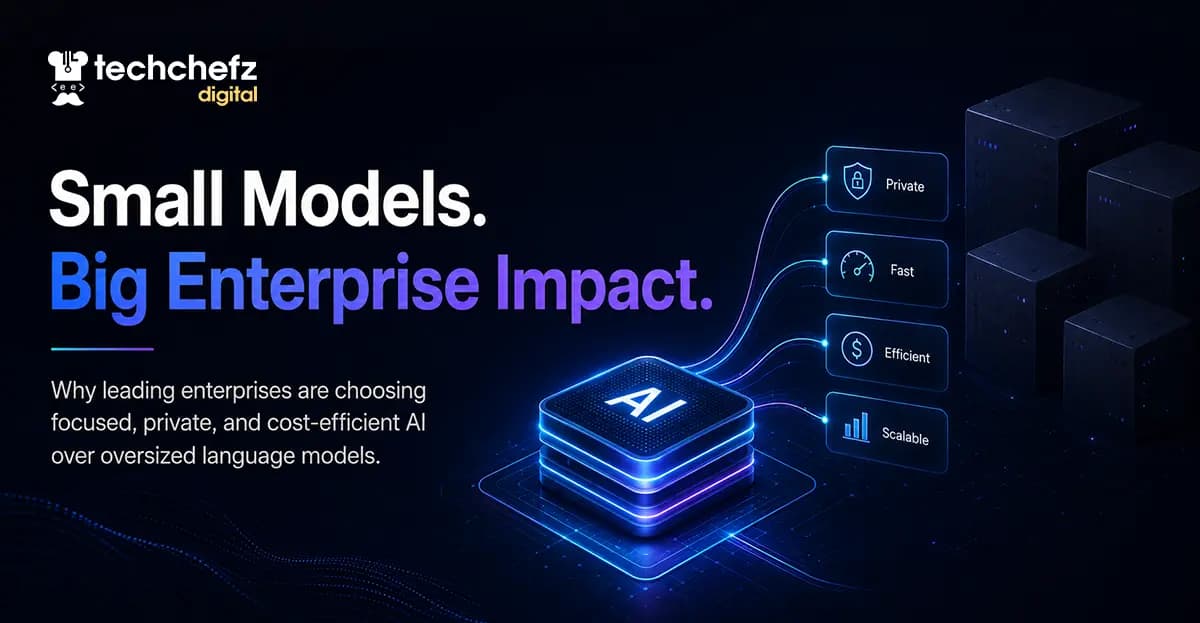
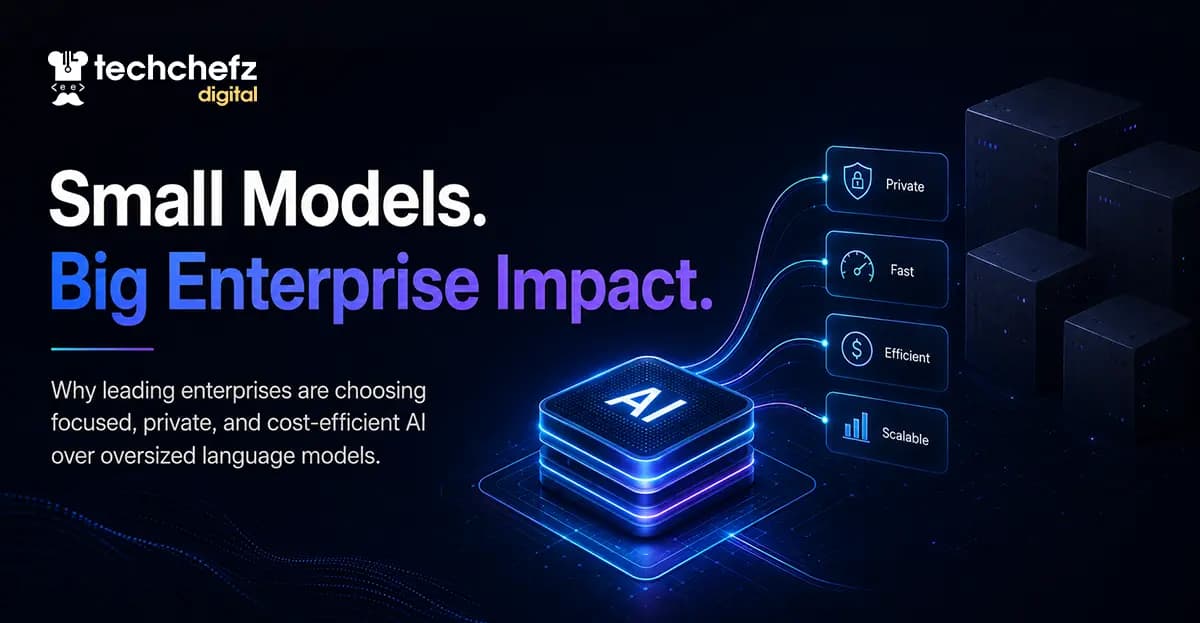
Leading enterprises are moving beyond the “bigger is better” approach to AI. Small language models offer lower costs, faster inference, stronger data privacy, and the flexibility to run on private or on-premise infrastructure—making them ideal for many focused enterprise workloads.
Bigger Isn't Better: The Quiet Shift From LLMs to Small Language Models
For the last three years, the enterprise AI conversation has been dominated by one idea: bigger is better. More parameters, more context window, more compute, more capability. Every procurement conversation started with "which frontier model should we standardize on," as if model size were the only variable that mattered. ``` Code ``` > **Quick Answer:** Leading enterprises are shifting from large frontier models to small language models (SLMs) for most production AI workloads because SLMs run on infrastructure the enterprise already controls, cost a fraction as much per call, and keep sensitive data inside the organization's own environment. Large models are still used, but reserved only for tasks that genuinely require broad, general-purpose reasoning. A small language model (SLM) is a language model built with a smaller parameter count and a narrower training or fine-tuning scope than a frontier model — designed to run on a fraction of the compute a large model requires, often on infrastructure the enterprise itself owns, rather than exclusively through a vendor's hosted API. That assumption is now being quietly retired inside the organizations that actually run AI at scale, where a smaller, sharper group of enterprise technology leaders has started deploying small language models for the vast majority of production workloads, while reserving large frontier models for the narrow slice of tasks that genuinely require them. This isn't a rejection of large language models. It's a correction. Enterprises that spent the last two years bolting a general-purpose LLM onto every internal workflow are discovering that most of those workflows never needed general-purpose intelligence in the first place. They needed something focused: a model that reliably classifies a support ticket, extracts a field from an invoice, routes a request, or summarizes a document — consistently, cheaply, and without shipping sensitive data to a third-party API every time it runs. Small language models are built for exactly that job. They are trained or fine-tuned on a narrower task surface, run on a fraction of the compute a frontier model demands, and — critically for enterprise buyers — can be deployed inside an organization's own infrastructure instead of a vendor's cloud. That combination is why the shift toward small language models is no longer a research curiosity. It is a procurement decision, a security decision, and increasingly a cost-control decision, made in the same boardrooms that greenlit the original LLM rollouts. ## Why 80% of Enterprise Tasks Never Needed a Giant Model Here is what most enterprise AI rollouts eventually run into: the overwhelming majority of internal AI tasks are narrow, repetitive, and structurally simple. They don't require a model that can reason about quantum physics or hold a nuanced multi-turn debate. They require a model that can do one thing correctly, every time, at low latency and low cost. Think about what actually runs through an enterprise's day-to-day AI pipeline: classifying inbound emails, tagging support tickets by urgency and department, extracting line items from a vendor invoice, summarizing a call transcript, checking a document against a compliance checklist, routing a claim to the right queue, generating a first-pass response to a routine customer inquiry. None of these tasks require frontier-level general reasoning. They require precision on a well-defined, repeatable job. This is the core reason roughly 80% of enterprise AI tasks never needed a giant model to begin with. A large frontier model applied to a narrow classification task is, functionally, using a data center to answer a multiple-choice question. It works, but it is disproportionate to the task — in compute consumed, in cost per call, and in the attack surface it opens up by routing routine internal data through an external API on every request. Small language models flip that equation. A model fine-tuned specifically for ticket classification or invoice extraction will often match or exceed a general-purpose LLM's accuracy on that task, because it isn't spending capacity on unrelated general knowledge — it's specialized for the job in front of it. Enterprises auditing workloads task-by-task, rather than deploying one model everywhere, are discovering how much of their LLM spend was solving problems a much smaller, purpose-built model could handle just as well. ## The Hidden Costs of Large Language Models: Overpaying, Cloud Data Exposure, and Network Latency The sticker price of a large language model API call looks small in isolation — fractions of a cent per thousand tokens. The problem is that enterprise workloads don't run one call; they run millions of them, every day, across every department that has integrated AI into a workflow. At that volume, the per-token economics of a frontier model compound into a real, recurring line item finance teams increasingly want explained. That's the cost problem enterprises can see. The one they're more concerned about is the one they can't fully audit: where their data actually goes. Every prompt sent to a hosted LLM API — customer records, internal financial data, proprietary process documentation, employee information — leaves the organization's own environment and travels to a third-party cloud provider for processing. Even with contractual data-handling assurances in place, that is still sensitive data crossing a boundary the organization does not fully control. For regulated industries — financial services, healthcare, insurance, government contracting — that boundary crossing is itself a compliance conversation that has to happen before any model gets deployed. Then there's latency — the cost that shows up in user experience rather than the invoice. Every call to a cloud-hosted LLM is a network round-trip: request out, queue, inference, response back. For a single ad-hoc query, that's invisible. For a real-time application — a customer-facing chat interface, a fraud-detection check ahead of a transaction clearing, an agent-assist tool surfacing an answer mid-call — that round-trip is friction the business feels directly, multiplied across every interaction, every day. Put together, these three costs — token spend, data exposure, and network latency — are precisely the three things the sharpest enterprise teams are now designing around when they choose small language models over large ones for the bulk of their workloads. ## Running Small Language Models Inside Your Own Walls: The Case for Private, On-Premise AI The single biggest structural advantage of small language models is one most enterprises underweight until they've already lived through the alternative: SLMs are small enough to run inside the organization's own infrastructure. A model with a few billion parameters can run on a single well-specified GPU, and in many quantized configurations, on standard enterprise server hardware — not a hyperscaler's data center. The model lives on infrastructure the enterprise already owns or directly controls: on-premise servers, a private cloud tenancy, or even an edge device sitting in a branch office or a manufacturing plant. The implications go well beyond convenience. Data never leaves the organization's security perimeter, so the compliance conversation that dominates every LLM procurement cycle — where does the data go, who can access it, how is it retained — simply doesn't apply. There is no third-party data processing agreement to negotiate because there is no third party in the inference loop. For a bank running fraud detection, a healthcare provider processing patient intake documents, or a government contractor handling classified material, that difference is the deciding factor in whether AI can be deployed on that workload at all. Running the model in-house also removes network latency entirely and gives the enterprise direct control over uptime, versioning, and update cadence, with no dependency on a vendor's API availability or unannounced model changes. This is what "private, on-premise AI" means in practice: a model an enterprise can inspect, fine-tune, version-control, and run entirely within its own walls. The part enterprises consistently underestimate isn't whether SLMs can run on-prem — they clearly can. It's figuring out which AI workloads actually qualify for this kind of deployment versus which ones still genuinely need a large model's broader reasoning. ## Phi-3, Llama 3, and the New Generation of Focused Enterprise Models The shift toward small language models isn't a theoretical preference — it's driven by a new generation of models built specifically for this kind of deployment. Microsoft's Phi-3 family and Meta's Llama 3, particularly its smaller 8-billion-parameter variant, are two visible examples, both engineered around the same premise: strong task-specific performance without frontier-scale compute requirements. Phi-3-mini is a compact model — small enough to run on a single GPU, and in some quantized forms, on high-end laptop or edge hardware — while still performing competitively on reasoning and language benchmarks against models many times its size. Llama 3's 8-billion-parameter variant offers a similar profile: open-weight, fine-tunable, and light enough to deploy inside a private enterprise environment rather than exclusively through a hosted API. Both represent a broader pattern: smaller open and semi-open models optimized for efficient, task-focused use over maximum general capability. What makes this generation different from earlier small models is fine-tunability. An enterprise doesn't have to accept the model as a generic assistant — it can be fine-tuned on the organization's own documents, terminology, and task patterns, producing a model that outperforms a general-purpose frontier model on the enterprise's specific use case, at a fraction of the running cost. ## The Sharpest Teams Are Already Moving — Most Enterprises Just Haven't Noticed The organizations making this shift aren't announcing it with press releases. It's happening quietly, inside platform and infrastructure teams, as a series of unglamorous but consequential decisions: this workload moves to a fine-tuned small model, that one stays on the frontier API, this one gets rearchitected to run on-premise entirely. But the gap it creates is real. A team running the right task on a small, private, fine-tuned model pays a fraction of the inference cost, exposes none of that workload's data externally, and gets a faster response — while a competitor running the same task through a general-purpose LLM API pays more, waits longer, and carries compliance exposure it may not have priced in. Over time, that gap compounds: in infrastructure budgets that scale sublinearly with usage, in compliance reviews that clear faster because fewer workloads touch third-party processors, and in product experiences that feel instant because the model sits on the same network rather than several hops away in a public cloud region. The shift is already underway. The only real question is whether an enterprise is setting the pace or catching up. ## What a Focused, Private, Lightning-Fast SLM Could Do Inside Your Infrastructure Set aside the industry-level trend and picture it applied inside a specific enterprise: a small language model fine-tuned on the organization's own support ticket history, running on infrastructure the organization controls, sitting close to the systems it needs to interact with. What does that look like in production? It looks like a customer service triage layer that classifies and routes every inbound ticket in milliseconds, without a single customer record ever leaving the company's own environment. It looks like a document-processing pipeline that extracts structured data from thousands of contracts, invoices, or claims forms daily, fine-tuned on the organization's own document formats, at a small fraction of an equivalent frontier-model API call's cost. It looks like an internal knowledge assistant, trained on a company's own policies, codebase, or product documentation, that employees can query instantly, with no risk of proprietary information reaching an external provider's servers. It also looks like resilience: no dependency on an external vendor's uptime, no exposure to sudden pricing changes, no risk of a model being deprecated out from under a production workflow with thirty days' notice. The enterprise owns the model, the weights, the fine-tuning data, and the deployment environment — and therefore the roadmap for how that capability evolves. None of this requires replacing every large model an enterprise currently uses. It requires an honest, workload-by-workload assessment of which tasks are actually general-reasoning problems that justify a frontier model's cost and latency profile, and which ones — likely the majority — are focused, repeatable jobs that a small, private, fine-tuned model can handle faster, cheaper, and more securely.
OTHER INSIGHTS
Explore More of Our Insights


















































DISCOVER MORE